
My Involvement in the MUMC
I joined the Melbourne University Mountaineering Club (MUMC) during Orientation week in 1962. I had done a fair bit of bushwalking connected with the 1st Beaumaris Sea Scouts, so it was a very natural choice. I had not done any rock climbing or snow/ice climbing.
I went on many trips – day trips to Hanging Rock (climbing), weekend trips to Mt Sugarloaf near Buxton for climbing, the Grampians and Mt Arapilles (climbing), Mt Baw Baw as well as several winter trips to Mt Feathertop. The Cross Cut saw, Mt Speculation, Bogong, The Pilot, Mt Kosciuszko and north to Mt Jagungal.
Most of the club trips had about 30 people and the common form of transport was to pile into a furniture removal van that had been fitted out with four rows of bench seats in the back. The engine was rather gutless and often going up the muddy track to Mt Sugarloaf we all hopped out and pushed.
In terms of starting rock climbing, I developed a close friendship with Doug Hatt who was doing Post-Grad in Zoology. I distinctly remember him merely walking up the 60 degree smooth “practice slab” at Sugarloaf with hands in pockets – such balance!
Doug led a winter trip to Mt Feathertop in 1962 (?). I remember the weather was rather wild above the “Cross” area to the summit. In 1963 Don Hutton led a winter trip to Feathertop and again the weather was a whiteout above The Cross so the whole group retreated down to the valley at Harrietville and set up camp there. However, a small group were allowed to climb to the summit early the next morning. I borrowed Don Hutton’s ice axe, and we had a rope. The climb to the summit was in strong winds and near white out conditions. By now I knew the shape of the mountain. I made allowance for the cornice by placing my right foot higher than my left on the way up. A small dip exists near the summit, and we crossed that. At where the steel summit pole was located (buried in snow and ice), the team anchored themselves and with a taut belay rope I ventured a short distance up the slope. The howling wind changed to a “swish” sound and when I looked down a large light blue crack between my legs briefly appeared and the crest of the extensive cornice disappeared. Fortunately, I had my weight on my back foot, so I did not go down with the cornice. Don’s ice axe did. We retreated carefully.
In the winter of 1964, I went on a trip to Pine Valley, The Labyrinth, Mt Hyperion, Big Gun Pass in the Cradle Mountain – Lake St Clair National Park, Tasmania. Doug Hatt led this trip. Others on the trip were Russell Judge, Barry Pullen and ?? Price??. It was a fantastic trip which was sort of a training trip for Doug and Russell’s planned summer trip to traverse Mt Cook in New Zealand. I was invited to NZ but had to complete a period of work experience doing surveying as part of my Engineering Degree. Otherwise, I may not be able to tell this story.
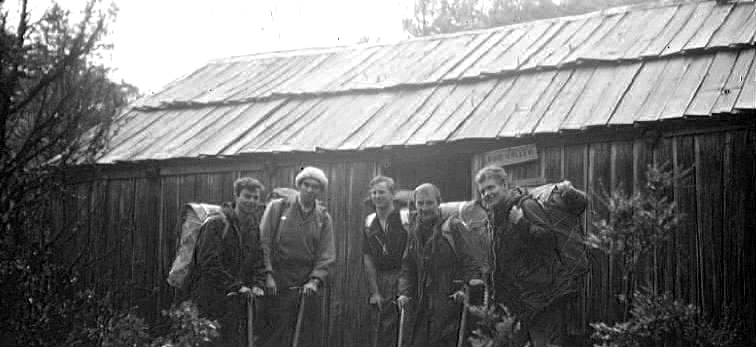
Left to Right: Peter Kneen, Barry Pullen, Russell Judge, Price (???) and Doug Hatt outside the Pine Valley hut before climbing up onto the Labyrinth in the winter of 1964.
News of the Deaths of Doug Hatt and Russell Judge (11 January 1965)
There was a MUMC social party early in 1965 where we heard that Doug and Russell had been killed in an avalanche on Mt Cook (January 11, 1965). They had spent several days in the Empress Hut waiting for the weather to improve before setting off. I think plans started at that party for the MUMC to do something. The MUMC was perhaps the most active club at the University.
Quite a lot of the details have faded from memory now but doing something on Doug’s favourite mountain – Mt Feathertop - headed the list. One option was a plaque – but where? This led to the concept of a large cairn at the summit like the one on Mt Bogong. I am not too sure of how the idea of a hut came about. Certainly, the existing cattlemen’s hut at The Playgrounds (the MUMC “Basecamp” site) on the Bungalow spur had seen better days. The hut had developed a lean and in winter the door was often blocked with drifts of snow. It was also located quite a distance down from the where one would be first exposed to the weather conditions areas above the tree line to the summit.
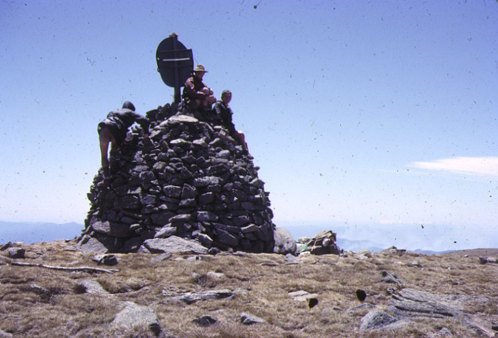
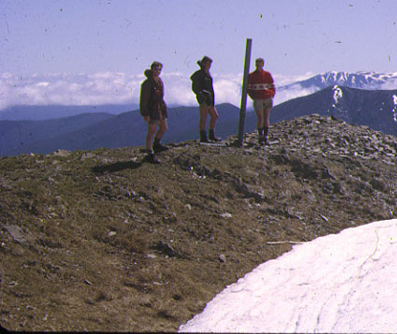
The Summit Cairn on Mt Bogong and the summit of Mt Feathertop (cornice off to right in winter)
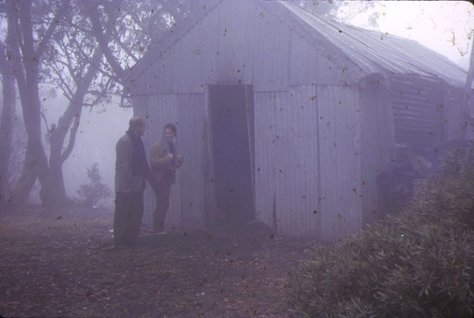
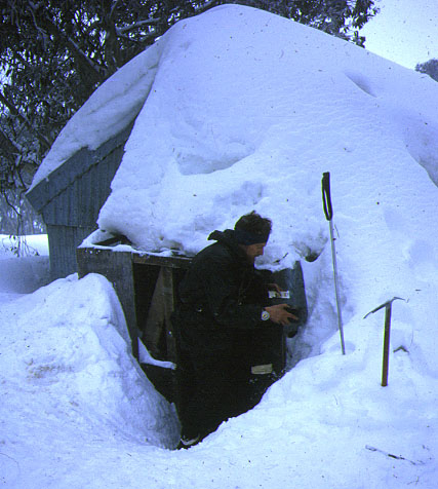
Existing Bungalow Spur Hut at The Playgrounds had seen better days. Bad access in winter!!
Some Background to my involvement in the Hut Design.
In 1965 I started my final year of the Civil Engineering course. I don’t quite remember exactly the process in my staying at Ormond College on campus for my final year – mum and Dad would have paid for it. Perhaps it was partly that my cousin Tom was in residence in another college. There are a few stories to tell there. However, living in did cut out the 2-3 hours per day travel times from Beaumaris to the Uni. I did work harder (or at least longer) at my studies. Maybe staying at Ormond might have contributed to me being looked towards to develop the concept of a “hut” as being the most appropriate thing for the MUMC to do. Initially a small model of a hut that attempted to address some of the pitfalls of many huts in the high country was made.
It had internal “A frame” bracing to prevent leaning and permit an upper level of bunk floor. It had a small internal air lock to reduce winter drafts.
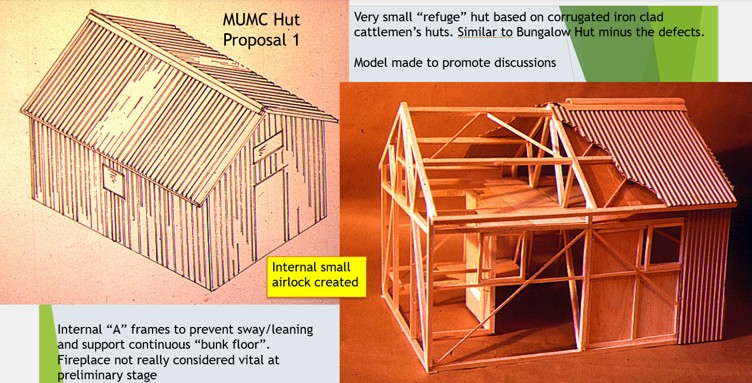
It is interesting to note that the first Federation Hut used these ideas. It was later burnt in bushfires and rebuilt using a different conventional design and flown in by helicopter.
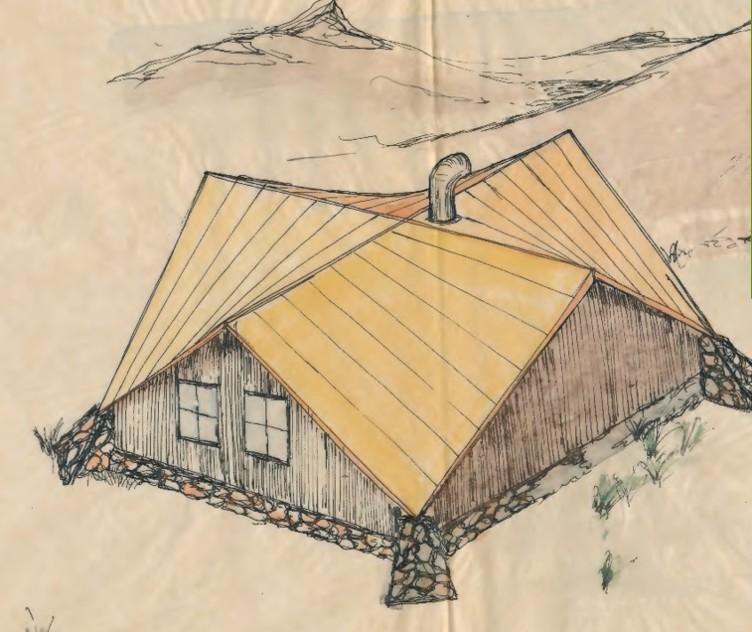
A second concept was partially developed using roof sheeting that could be twisted and supported on straight roof purlins at right angles. Some influence from the stonework of the Cleve Cole hut on Bogong and a toilet block roof near Mentone Beach!! Did not progress. The use of hypars surfaced some 8 or 9 years later with the lower shells of the Victorian Arts Centre.
The club had a special meeting on campus (24th September 1965) to look at factors and the preliminary design work I had done. After the first two designs got a quiet reception, I put forward an idea that something along the lines of an “igloo” was forming in my mind. “Go for it!” was the reaction and from that time that was the only option developed.
Five motions were passed at that special general meeting including a) that the hut be built, b) the site was on the NW Spur, c) the ¾ sphere igloo concept be adopted. The other motions were concerned with establishing a Hut subcommittee and financing of the venture.
WOW – approval at the end of September and on-site construction starts in mid-December with all the dome bits and pieces prefabricated!
The Igloo Concept for the MUMC Memorial Hut.
Some underlying criteria were not written down but came into play when the concept of the Igloo design was developed.
- Winter club trips to Mt Feathertop quite often had about 30 people going – hence it would be larger than most, if not all, existing huts in the high country.
- The site of the hut ideally should be close to the tree line so that people could gauge the weather conditions before heading off to the summit in winter.
- The entrance would have a reasonable sized airlock or tunnel so that when people came and went the icy blast would be greatly reduced in the main room.
- The airlock should have enough room for the storage for quite a lot of wet gear such as ropes, ice axes, parkas and the like.
- The entry door should be above the surrounding regular snow levels and open inwards.
- There should be a few windows to enjoy the view and monitor progress of parties heading to or from the summit. This only came into play after a suitable site was determined.
- Ideally there would be a “bunk floor” with as few internal supports as possible.
- The hut should be very resistant to wind and snow loads.
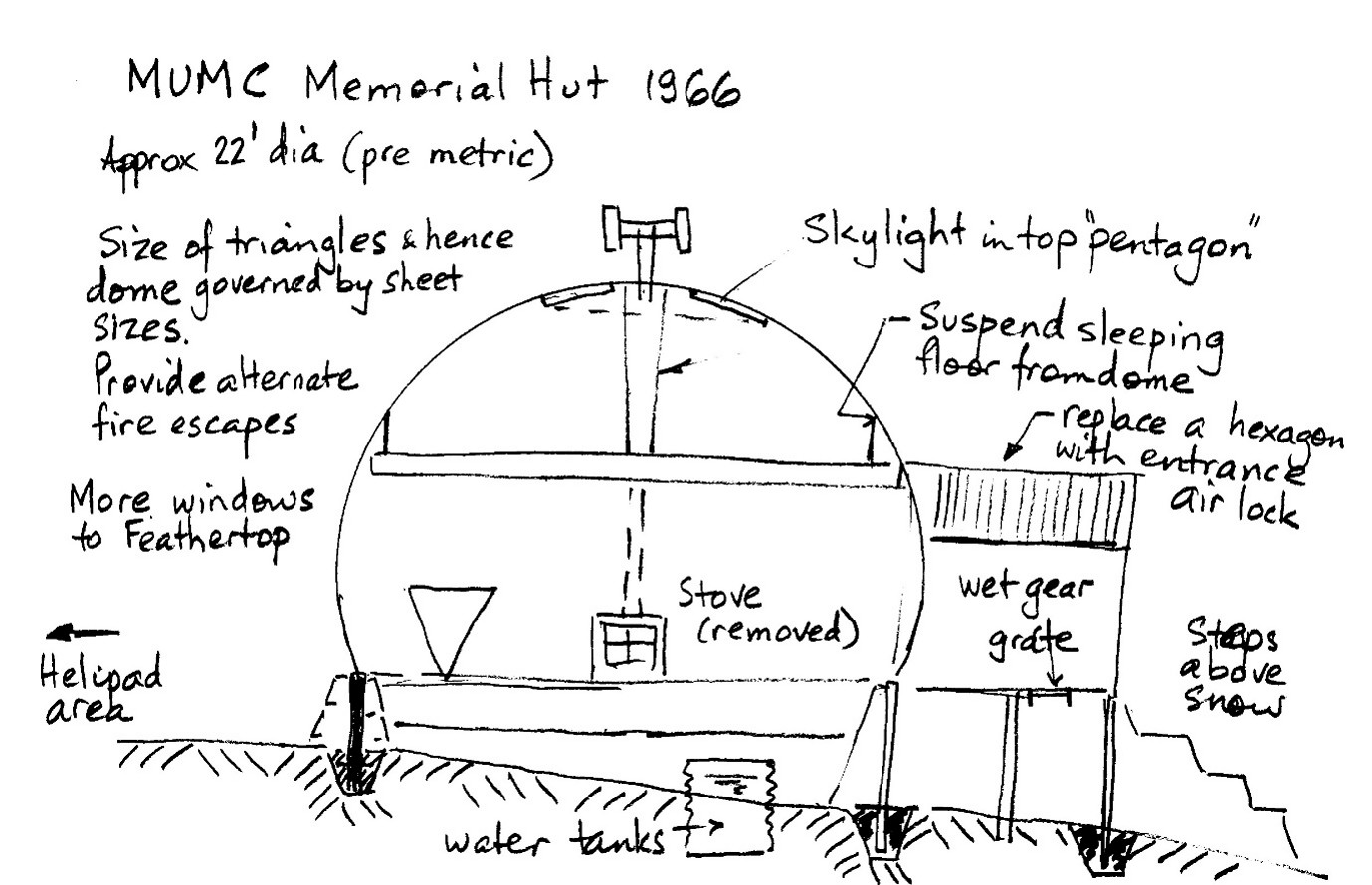
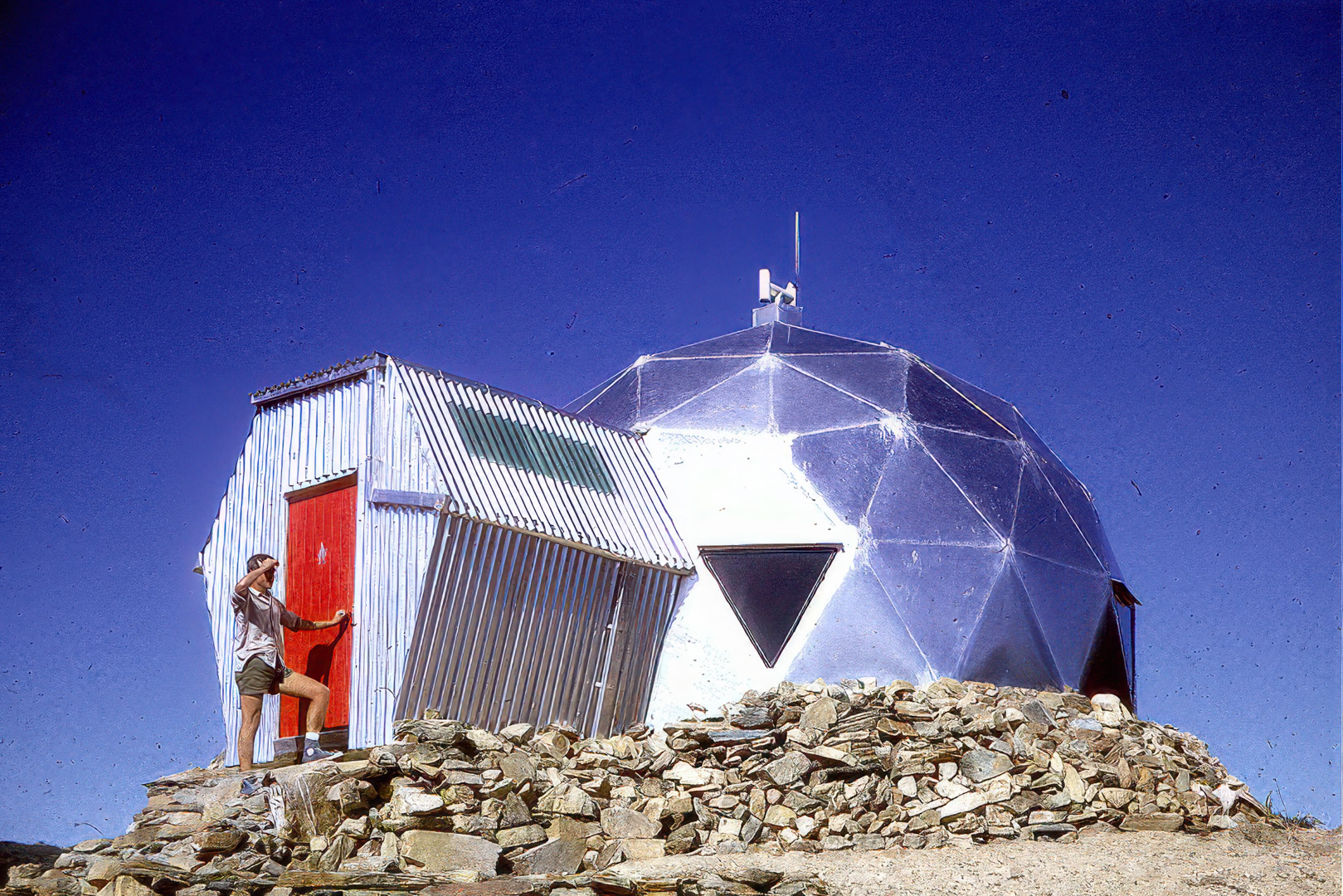
The concept (drawn up in 2017 for a presentation to the Club). and reality a year or so later. It was considered to be complete in 1967.
The subdivision of the icosahedron (3-frequency) gives a triangulated surface of pentagons and hexagons. These were covered with overlapping flat sheets of Aluminium pop rivetted to the framing members. The entrance structure is clad with conventional (Aluminium) ribbed sheeting and protected gutters.
Finding the Site for the Hut
The criteria were that:
- it should be higher in altitude than the existing Bungalow Spur hut – preferably at or above the tree line.
- that it might be off the beaten track to reduce vandalism and “day walkers”.
- ideally, should command a good view of Mt Feathertop and in other directions.
- Access for construction did not really restrict the choice.
One the Queen’s Birthday weekend in 1965, John Retchford, Dave Allen and I went to Feathertop via the North Razorback. From the summit we noticed a pronounced nearly level ridge running N-S at about the tree level. A spot at the northern end of this ridge appealed to us. Descending to the “Cross” we could also see the spot. If a new track up from the valley was built then the spot would be the first location that would be exposed to potentially bad weather – low cloud, strong winds, driving snow etc.
Dave Allen (L) and John Retchford at the Cross surveying the position of the proposed MUMC Hut on the “NW Spur” (just to the left of picture). From the Razorback (R of picture) we could envisage a track contouring around (from John’s head in the picture) going out to the Hut. The NW Spur would be off the normal routes to Feathertop. This track contouring around passed a reliable source of spring water. It was later to be known as the Tom Kneen track following the death of my cousin on Feathertop.
Obtaining Permission to Build the MUMC Hut
Two members including myself from the MUMC met with Parks Victoria to put the proposal for a Memorial Hut. According to Parks Victoria the location was just inside the boundary (by a few metres – the comment was made that the boundary could be moved so that it was inside). As a result, we would be subject to their conditions.
We presented the conceptual igloo design which seem to interest them. I think that perhaps they were thinking it was all pie in the sky and would not happen. The two valuable criteria imposed were that fire escape features be added and that as a “refuge hut” it must remain open to the public. Thus, a tomahawk was placed near the top to cut through the top fibreglass sheets and some of the ground floor triangular windows opposite the entrance be hinged to allow egress.
Several months later – I think after construction started – Parks Victoria placed a ban on the construction of the hut. I went to see them armed with my computer analysis print out and some drawings of details as developed. Thankfully they lifted the ban almost immediately and work on site proceeded at a frantic pace. In hindsight it is difficult to believe how little red tape was put in place.
Aside: I do not know where this information is located now. In 2017 there was mention that there were some papers in the MUMC Archives but I am not convinced. I do not have a copy.
The Development of the Bespoke Joint
Fairly early in the process the members of the dome would be made from 3x2 inch rectangular hollow Aluminium tubes with rounded corners. The 3inch dimension would be in the radial direction. After quite a bit of thought, and probably influenced by the adopted use of pop rivets and Aluminium sheeting a “double star” joint evolved with one star pop-rivetted to the outer faces of the tubes and the other on the inside faces.
A sample joint was made and tested in the University testing laboratories. Some distortion of the star plates led to a short section of the framing members being bolted between the two stars in the space between the intersecting dome members. This improved the load carrying ability significantly.
Two views of the adopted “Star Joint”. These are for the base joints but are similar for the other higher joints in the dome. The various legs were pre-drilled for the poprivets in the workshop. The strengthening piece of framing member between inner and outer faces can be seen.
During erection, G Clamps were used to clamp two members to the new joint. The target marked in the star joint was lined up at the correct angular position (horizontally and vertically) by means of a Theodolite located at the centre of the sphere. The radial distance was measured with a steel tape. When in the correct position the holes for the pop rivets were drilled, the surfaces abraded, araldite applied and the parts rivetted.
Professor Len Stevens who was also supervising my final year research project was very supportive of this project and encouraged the testing as well as organizing the after-hours use of the workshops where club members produced the joints and cut the dome members to size. I cannot recall if the triangular sheets were cut at the University of not.
Aside: During the testing of the joint, Prof Stevens told me about the Academy of Science Dome in Canberra designed by Sir Roy Grounds some years earlier. A fibreglass model of the concrete dome was made and fitted out with strain gauges to measure the stresses. Roy Grounds had arrived early for the meeting and was found sitting on this delicate model!
I was later to work with Grounds on the Victorian Arts Centre. There is no doubt in my mind that this would not have happened if I hadn’t done the work on the MUMC hut and had Prof Stevens as a mentor.
Detailed Geometry
The geometry is based on a regular Icosahedron which has 20 identical equilateral triangles. Five such triangles would meet at a vertex.
The geometry was based on a regular icosahedron
Each side of the triangles was sub-divided into three and the intersection points of the joining lines was projected outwards to be on the surface of a sphere. Many people refer to the formed geometry to be a “geodesic dome”. This process resulted in a series of “pentagons” and “hexagons”. A pentagon was selected to be the top vertex of the hut.
Cladding of the Dome
The dome itself is clad with flat, overlapping triangular sheets of Aluminium. From a structural point of view the overlapping sheets – pop rivets through both overlapping sheet and to the Aluminium hollow rectangular framing member – would mean that the snow loads (designed for 100 psf) would be carried by tension in the sheets rather than by bending. My first application of tensioned membrane action!
The cladding of the entrance airlock would be by more conventional ribbed Aluminium sheets and water would be collected from these and fed down into two 100 gallon water tanks below floor level.
Finalizing the Geometry
Having settled on the 3-frequency subdivision of a regular icosahedron and the method of cladding the dome, the final dimensions were governed by the available size of the flat sheets of Aluminium to be used for the cladding. It is likely that the sheet sizes were 4 foot wide – or 1200mm approximately. Allowing for the overlaps to join the triangles and for a short flat area at a vertex of the triangle (where 5 or 6 sheets would come together). The number of such triangles fitting into the length of an available sheet dictated the quantity of sheets and influenced the number of triangular windows.
The upper bunk floor was suspended from a series of joints at roughly the same level as well as the top apex of the dome. The headroom above was okay – people were not expected to be walking around upright. Heads were to be away from the centre so some crawling into sleeping bags was expected and normal.
The Upper or Bunk Floor is suspended from the central joint and from a level of joints on the outer edge. People slept with feet pointing to the centre. Acceptable standing room near the centre. Photo 2010.
The bottom level of joints in the main floor were bolted to 5 inch square redgum posts. The height of the base joints was adjusted to give a suitable head room on the ground floor. The region between the bottom joints and framing members was filled with broken rocks from the excavations. The redgum posts were set in concrete and keyed into the rock wall which provided more than adequate resistance to uplift forces from the wind.
The clear space below the suspended bunk floor. The height of the rock wall and support posts was adjusted to give good clearance on the main floor. Photo 2010
Over time the internal face of the rock wall received plaques for the growing number of MUMC members killed in climbing accidents.
The original plaque for Doug Hatt and Russell Judge – 1966.
Some People Involved in the Details
There were many club members involved in the project – raising money etc. During construction there were also many involved to cater for the “workers”. There were hundreds of different club members attending and carrying in loads of building materials.
As far as the hut design is concerned:
- Ian Thomas carried out the calculations of the geometry using spherical geometry. A folder of his calculation existed at the time, but its location is no longer known.
- Tony Kerr did quite a lot of work on the geometry of the individual triangular sheets so that they might be cut on a guillotine.
- Tom Kneen organized and did the calculations for the triangular windows and the triangular plywood bunk floor sheets.
- Roger Caffin’s father worked at Comalco and this would have helped with the purchase of the Aluminium.
Left to Right: Ian Thomas, Peter Kneen, Cath Milvain (now Kerr), Tony Kerr and Tom Kneen. Circa 1965
Building the MUMC Hut
There was a very active Hut sub-committee that did an enormous amount of fund raising, gathering of building materials, prefabricating components and a host of other tasks. Then there was “Nina’s Kitchen” – Nina Rulervich would cater for the group of workers so that they could concentrate on carrying the materials from the end of the 4WD track below the North Razorback.
Constructing the NW Spur Track
Having settled on the site it was necessary to build an access track from the Ovens valley near the Trout Farm straight up the NW Spur to the hut site. Good progress was made.
Don Thomas, Dave Allen benching the new access track. Robyn Freer (then girlfriend of Doug Hatt) crossing a stream.
Whilst the NW Spur track was and still is used to access the hut by foot, the bulk of materials were carried in from the end of a 4WD track near the North Razorback. I am told that a friendly bulldozer driver extended the timber getting road a few kilometres (?). Because of this road being for timber jinkers, there were no major cross drains and the club were able to get normal cars to the top although sometimes the steeper grades were a bit of a challenge if wet.
On-site Construction starts after the University Exams
The on-site construction started the weekend after the Exams in December 1965. Whilst there was a brief interest in building the dome itself down near Harrietville and helicoptering it to the site this didn’t get off the ground. Some people thought of pack horses but in the end it was simply man power – and I didn’t hear any complaints.
The bulk of the materials were carried in from the North Razorback towards Mt Feathertop. Where this ridge started to climb the track used contoured around the NW face of Feathertop, just above the tree line. In those days cattle were permitted in the high country during the summer months and we were able to follow a fairly well formed cattle pad around the side of the mountain. The route joined the ridge located just to the north of the water spring then out northwards along the pretty level part of the NW Spur.
Initially the base camp was about 1 km from the hut site in a grassy area above the creek (starting at the spring) where we collected aggregate and water for concreting the foundations.
Taken looking North from The Cross, the completed hut is the distant bubble under the snow gums. Most materials were carried from the high point on the North Razorback to where the ridge climbed to the summit (out of picture to right of single snow gum). The cattle pad joined a ridge running NW from the summit near the grassy saddle on the closer ridge. The original base camp was at the low point at the centre of this picture.
Sifting for aggregate in the creek near the base camp. Bags of cement and sand were later carried in (prior to premixed 20kg bags of quick set concrete!)
Excavations for the Toilet and Basement.
Doug Hatt would appreciate a view of distant mountains whilst attending to this daily chore. Maybe this led to us starting to excavate a hole about 15-20 metres directly in front of the entrance. Dave Allen who worked in Benalla for the Country Roads Board had carried in a rock drill and some explosives. A hole some 1.5-2m deep was formed and the shattered rock was excellent for the drystone walls of the hut. But the toilet concept was abandoned, and this hole became a rubbish pit for a year or two – later to be cleared out.
The basement was required to house two 100-gallon water tanks which were carried in.
The 100 gallon tanks coming in. On the left the peak over the tank was the start of the trip. The right picture is coming around the NW face of Feathertop following the cattle pad.
The Kitchen Sink and Other Awkward Loads
Perhaps the most difficult loads were the 5x5 inch redgum foundation posts. These had substantial weight and if a sudden move happened it would be difficult to control – especially if the bottom was to hit the ground.
The Little Feathertop Hut
Bob Vincent assumed the role of designing and building the dunny or Little Feathertop Hut as was called.
Views of the Little Feathertop Hut. It was burnt by the 2003 bushfires and replaced by a much larger Parks Victoria model with facilities for helicopter removal of waste (as per the now existing Federation Hut).
The Dome is Built
Excavations, flooring and Rock Walls
After the basement was excavated and holes dug to accept the redgum posts, the main bearers and joists were placed. These were spaced slightly more than common in order to reduce the number of pieces to be carried in.
The Base Level of Joints
The 5x5 inch redgum posts had sufficient excess material to accept the lowest level of the bespoke star joints. This meant that there was a fair bit of tolerance in the position of the posts.
In the left photo you can see the excess material has been removed from the posts. On the right Ian Thomas and Tom Kneen drilling the holes for the pop rivets in the “horizontal” members – the holes in the arms of the star joint had been pre-drilled.
As noted, the geometry was determined by spherical geometry and the design of the bespoke joint meant that there was a degree of flexibility in connecting the various tubes together. An essential step was to use the theodolite accurately set up at the centre of the sphere and to measure the various angles in plan and elevation coupled with the correct radius from the sphere centre.
Peter Kneen using the theodolite to measure the angles. Don Thomas checking the radius and clamping the inner star plate to the two new members used to add a new joint.
Higher Levels Added
Aside from a few hours set back when the theodolite could not easily be set up and orientated correctly due to heavy fog (the target was the Trig station on Mt Fainter), the dome grew rather quickly.
The Top Pentagon
This was assembled on the ground and was lifted up through the dome and positioned before being pop riveted to the completed frame.
The top pentagon assembled on the ground (Mr Edgar C Kneen on left) and then lifted into position and made fast.
Adding the Front Entrance
One hexagon was omitted at the entrance and the air-lock portion of the hut was framed with hardwood members. This was done using triangles to avoid the problem of a lean being developed over time. The hexagonal cross section created room for some shelving. Later it is understood that a rescue stretcher was suspended in the air-lock. There is a hinged metal grate giving access to the basement which permitted wet snow to be stamped off boots on entry.
Framing for the entrance air-lock being installed and Tom Kneen putting in a window. Easter 1966
Completing the Hut
Work on the hut slowed for the winter months. The floor, entrance foyer bunk floor and windows all needed to be completed. The completion date was later accepted as 1967.
Some Shortcomings
There were complaints from the valley that the hut had unacceptable reflections. Over a few years the Aluminium sheeting did not dull and the club selected to paint the hut. “MUMC Hut Green”
Another shortcoming was internal condensation especially when larger number were staying in winter. Various attempts to address this may continue.
There were also minor leaks from the main joints. When constructed the use of flexible silicon products were not known about. The club has had several attempts to rectify this problem.
Another characteristic was acoustics – couples whispering sweet nothings could be easily heard all around the upper bunk floor – but it was difficult to determine the exact source. Snoring has been mentioned.
Additional Notes (Jan 2025)
Equipment Used
Some items of equipment used included:
- a pneumatic jack hammer to dig a large hole for the originally proposed toilet directly in front of the entrance – “the room with a view” to Mt Fainter and Bogong. Toilet abandoned in favour of the “Little Feathertop Hut” by Bob Vincent and later the helicopter model by Parks Victoria.
- Survey equipment notably a theodolite and tripod that was set up at the centre of the sphere at the start of each work session. On loan from University of Melbourne School of Civil Engineering and Surveying. Was hidden in the bush when not in use.
- A petrol driven generator mainly used to provide 240V to the hand held electric drill(s) used on the job. These drills were used to drill the holes to accept the thousands of pop-rivets that were used in the construction. The generator was also used to provide lights to permit construction to continue after dark
The type of “star” connection for the nodes has been described and the pop-rivet holes were pre-drilled in the workshop at the Civil/Mechanical Engineering School at the University of Melbourne. These predrilled holes served as locators for the inside and outside faces of the hollow rectangular Aluminium framing members.
Additionally for the dome cladding the adjacent triangular Aluminium panels were firstly abraded to ensure adhesion of the araldite epoxy, then overlapped and drilled through the two cladding sheets into the outside face of the dome framing members. - Assorted hand tools such as crow bars, picks, saws, hammers, spanners etc.
Added note for the Specific Siting and Orientation of the Dome.
There was a visible (through the telescope of the Theodolite) Trig station located on Mt Fainter. The axis of the dome lines up with the trig station. Behind the dome there is/was a flat area with small rocks about 300mm high and little bush. It was planned that this would be levelled and marked as a Helipad for potential Search and Rescue. The centre of the dome is located sufficient distance from the planned helipad towards Mt Fainter such that the height of the front entrance was expected to be clear of snow thus avoiding the problems of snow drifts building up preventing access during the winter. The front door was to open inwards.
Estimate of the Number of Poprivets used.
A record of the number of rivets used was not kept. It can be seen from several of the images that from 8-10 holes were pre-drilled in each arm of the star connector plates.
Assuming there are 160 members each end connected to an inner and outer arm of a star connector gives 160 x 2 ends x 2 faces x 8 rivets = 5120 rivets.
For the joining of the overlapping Aluminium or top pentagon fibreglass panels, the estimate is perhaps less accurate. However, assuming 160 members of approximate length 1350mm and rivets spaced at 2 inch or say 50mm spacing gives 27 rivets per side of triangle. But say 25 to allow for the situation at each joint. Thus this would give 160 x 25 = 4000 rivets.
In total approximately 5120 + 4000 = 9120.
Plus other fasteners to clad the more traditional entrance tunnel.
Nearly Destroyed by Bushfires 2003 and 2013
The Hut Project upon Reflection
It is a unique structure in a superb location. It was constructed in a very short time frame but the time input from a very large number of MUMC members was extraordinary. It remains the largest project undertaken by the Club and was instrumental in many lifelong friendships being developed.
It was marred by a fatal car accident during construction, and it is thought that the project would not be contemplated again if the amount of effort was known at the start.
The MUMC continues to maintain the hut and has some club trips. One tradition, started by Tom Kneen is the “Midnight Ascent” where participants dress up and share in a big feast on the night closest to a full moon in mid-winter. For a recent description see the MUMC website at https://www.mumc.org.au/midnight-ascent